Sauran and Turkestan — The Silk Road Connection

As a child, I was mesmerized by the Silk Road, imagining it magically paved with elegant silk, camel caravans carrying exotic goods along its path. That childish image is long gone, but my fascination remains — not only with the cities that still flourish, but also with those that were abandoned and often forgotten, along what was once a network of Asian trade routes used from the second century BCE until the mid-fifteenth century.
Two of these cities have long captured my imagination: Turkestan, a still-thriving city that was once a major stop on the Silk Road, and the nearby, long-abandoned Silk Road city of Sauran.
Turkestan

We’ve just arrived by local bus in Turkestan and are excited to explore, so it's off to our hotel for a quick drop-off of our packs. Or so we thought. But not this time. A request on Yandex, the ride-sharing app, quickly brings a driver, but he can't find our hotel — it’s too new to be in the system. After many false leads, we finally arrive. We make a mental note to choose a recognizable nearby landmark as a pick-up and drop-off point as we head in.
As usual, no one speaks English, but between Google Translate and hand signals, we’re taken to our room. Heading to the bathroom, I feel heat rising from the toilet. Huh? Turns out the toilet has mistakenly been hooked up to the hot water, making for an interesting experience.
A short ride from our hotel is the Mausoleum of Khoja Ahmad Yasawi. We stand transfixed by the massive structure, one of the best-preserved buildings of the Timurid period. Turkestan, formerly known as Yassi, became a major pilgrimage site in 1389 when Timur, a Central Asian conqueror, visited and demanded that a mausoleum be built for the revered Sufi teacher Ahmad Yasawi, a contemporary of Rumi.


Despite never being finished due to Timur’s death, this architectural masterpiece, with its resplendent blue and turquoise tile-work, is a testament to the glory days of the Silk Road. Now a UNESCO World Heritage Site, it remains popular for pilgrims from Kazakhstan and neighbouring countries. Sometimes dubbed the Second Mecca of the East, it’s said that visiting the mausoleum three times is considered to equal the Hajj to Mecca.


We wile away a couple of hours in the well-kept gardens watching a steady stream of pilgrims. Some, hearing us speak English, want photos with us. For now, Turkestan remains off the beaten path, but that’s about to change with plans to build a Disney-style theme park.


Sauran
We head back to our hotel to confirm our driver to Sauran. All is arranged for the forty-five-minute drive the following day. We leave bright and early, but our driver, seemingly unfamiliar with the area, can’t find it, taking a path so rugged that it’s miraculous we don’t get stuck. Finally, spotting the ancient walls in the distance, we breathe a sigh of relief.
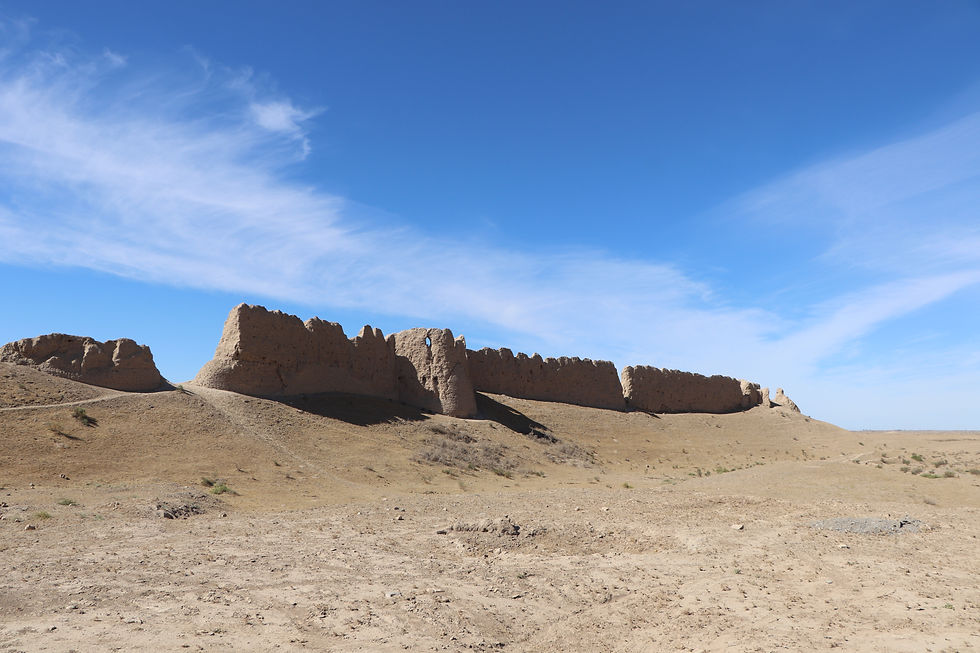
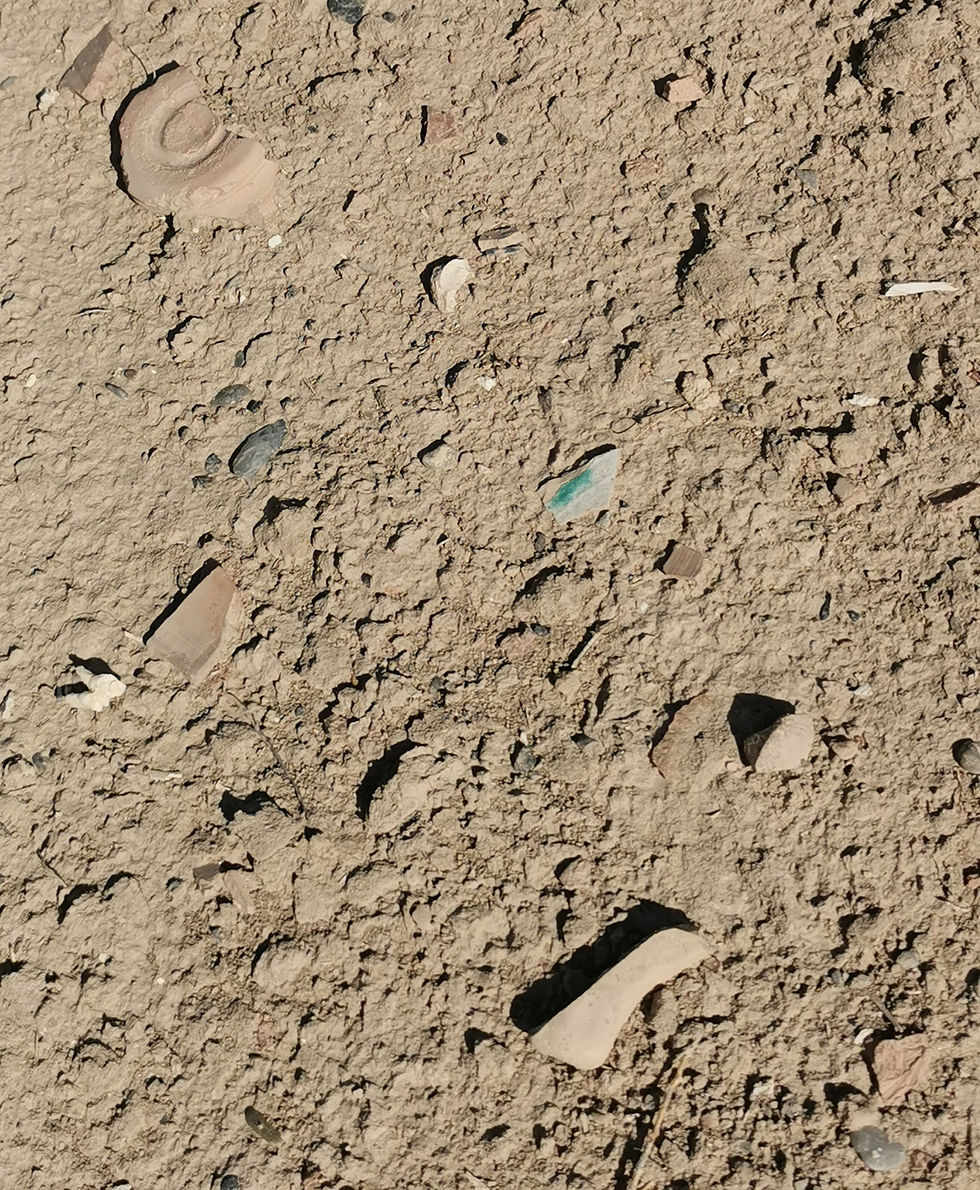
An absolute stillness greets us as we arrive. The ghosts of the past remain silent as we walk through the large gates of what was the ancient city of Sauran. Keeping secrets to themselves, remnants of the only surviving mud-brick walls in Kazakhstan still stand guard over this medieval city. But telltale signs of what was once the largest city in Kazakhstan are everywhere in this fifty-hectare archaeological complex — pottery fragments of yellow and blue, strewn everywhere, crunch under our feet.

The only people at the site, we meander to our hearts' content, enchanted by our solitary journey into the past, imagining the former glory of this major stop on the Silk Road. From the hills, we can make out the layout of Sauran. Partial excavation reveals pieces of structures such as stairs, house foundations, cooking areas, and the outline of a mosque — all hinting at the richness of life, the calls to prayer ringing out over the city, and the hustle and bustle of the markets.
Sauran managed to survive the Mongol onslaught, but its sophisticated system of underwater canals in this oasis city couldn’t survive the eventual drying up of its water source. Inhabited since the 13th century, Sauran was abandoned in the 18th century, and many of its inhabitants moved to nearby Turkestan.

On our drive back, visions of the ancient city swirling in my mind, I contemplate the long history of the Silk Road and the civilizations that have passed through this earth before us.


Comments