Papantla, Mexico —Where Ancient Rituals Come Alive
- Cheryl

- Jul 27
- 6 min read
Even the rain can’t dampen our enthusiasm upon our arrival in Papantla, Veracruz, one of Mexico’s famed Pueblos Mágicos, or Magical Towns, chosen for their cultural and historical treasures or natural beauty. Seeing La Danza de las Voladores, or the Dance of the Flyers, an ancient Mesoamerican ceremony continued by communities of Totonacs, an indigenous people of Mexico who maintain their culture and language, has long been on our bucket list. Founded in the 13th century by the Totonacs, the name Papantla, meaning place of the papanes (a species of crow), is from Nahuatl, the most widely spoken indigenous language in Mexico.


However, we have to put our enthusiasm on hold. The daily performance of the Valadores at El Tajin, a pre-Columbian archaeological site located just outside Papantla, is cancelled due to the rain. In the meantime, we sit on our large balcony overlooking the town, but my cell phone, which I usually ignore, is constantly pinging. The Mexican government has killed the cartel leader El Mencho and an escalating wave of violence has begun. Soon, friends and family are texting to make sure we're safe. We never feel in danger — we’re1200 kilometres from the epicentre in Tapalpa, but initially, everyone is on high alert.
We share the breaking news with Lupe, the gracious owner of Posada Familiar, where we’re staying, who invites us in to watch the newscast on her TV. She is nonchalant about the killing, simply shrugs her shoulders and says, “Well, one less.” Mexicans that we speak to are, by and large, unimpressed by the killing, knowing all too well that there will be no lasting change as cartels are deeply entrenched and control large swaths of Mexico.

We go ahead with our plans to visit El Tajin the next day. The ever-helpful Lupe directs us to the collectivos — a low-cost alternative to taxis or Uber that leave only when full. Ours is filled within minutes and we’re on our way.
We arrive, only to find a large closed sign on the entrance gate. Disappointed, I ask a guard why. “Seguridad,” he says. We’re not surprised that the government is taking extra precautions, given the violence. The Flying Valadore performance held just outside the site is also cancelled, but we’re assured by one of the Valadores greeting visitors that it will go ahead tomorrow at noon.

And go ahead, it does. La Danza de las Voladores is one of the most breathtaking sights we've ever seen. First, five men engage in an ancient ritual dance ceremony to communicate spiritually with the gods and celebrate harmony with nature. Then, one by one, all five men begin to ascend a 30-metre-high mast. One of the men sits on the top, playing melodies on a flute and drums to honour the spirits, while the other four, tied to the top by ropes around their waist and one leg, hurl themselves upside down from the platform. As the rope lengthens, they spin like birds in flight, slowly descending, righting themselves just before they hit the ground.


As spectators, we can feel the spirituality of the performance and gain a profound sense of respect for their traditions and cultural identity.
Still pumped from the performance, we enter El Tajin. We decide to hire an English-speaking guide as there are few signs and we want to learn more about this archaeological site, one of the largest, most important and best-preserved in Mesoamerica. Flourishing from 600 to 1200 CE, it remained unknown to the outside world from its fall until it was stumbled upon by a European government inspector in 1795. Named after the Totonac rain god, it was designated a UNESCO site in 1992.


Our first stop is one of the dozen ballcourts, but surprisingly, they weren’t used just for sport. They were theatrical spaces with carved decorative panels showing sacrifices, all of which are a reflection of an emphasis on ritual. Incredibly, traces of red and blue pigments still remain on some of the walls and niches. Step-facade temples used recessed panels that repeat to capture ceremonial rhythms. Especially captivating is the Pyramid of the Niches, holding precisely 365 niches, indicating solar cycles.


We ask our guide why some structures, although grand, seem unfinished. All are indications of Tajin's decline, abandonment and jungle reclamation, he explains. Our tour finished, we say goodbye to our guide and meander back through inviting plazas.`
We’ve seen many ancient sites and just thinking about the accomplishments of these ancient civilizations never fails to blow us away.
It was the Totonacs, an indigenous people who still inhabit several municipalities in northern Veracruz, and may have been the builders of El Tajin, who first discovered vanilla vines growing wild in present-day Veracruz state and began to cultivate it. Vanilla was sacred to the Totonacs. They used it for ritual offerings, perfumes and medicine, but surprisingly not for cooking. Vanilla gradually made its way to Europe via Spanish colonizers and became a hit with the aristocracy, making Mexico the world’s largest supplier. But vanilla is notoriously difficult to cultivate.


We’re about to find out just how challenging it is on a visit to a vanilla-growing site in Papantla. Vanilla beans grow only on a vanilla orchid and require precise environmental conditions and continuous maintenance. Flowers usually appear after two or three years. Originally pollinated by the stingless Melipona bee, which is endemic to Mesoamerica, vanilla is now pollinated by hand and is the most crucial labour-intensive phase of cultivation. Each blossom opens for only twenty-four hours and must be pollinated or will wither without producing a pod. Skilled pollinators, with the dexterity of surgeons, pollinate 1,000–1,500 flowers a day. It will still take another four to nine months for the vanilla pod to grow and mature.
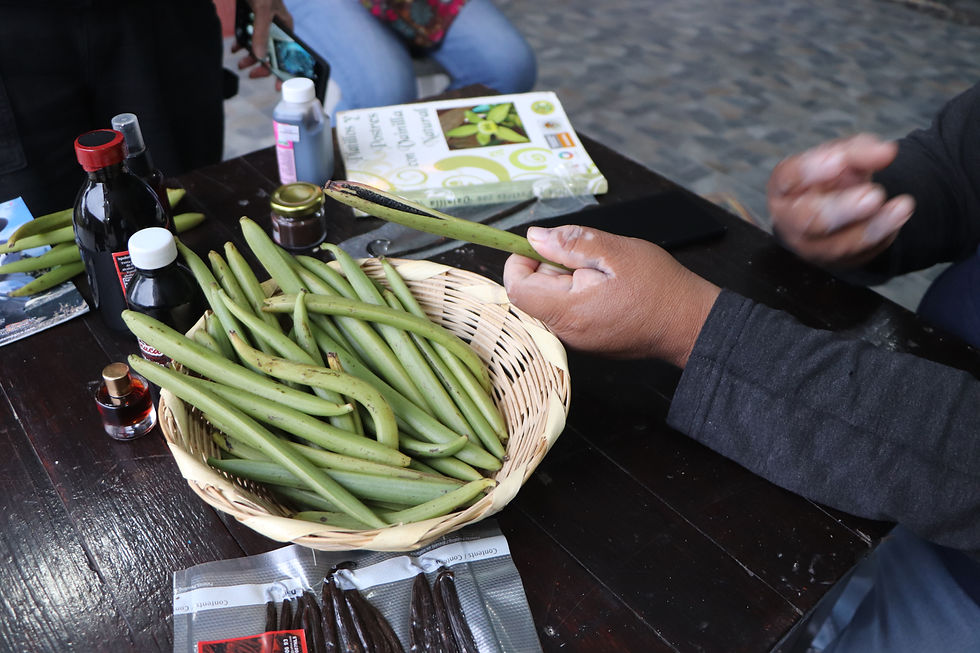
Curing and drying the pods takes two to four weeks, and in the final conditioning, the pods are stored in closed boxes for several months to develop their aromatic complexity. We’ve always wondered why the price of vanilla was so steep. Now that we know, it’s the real thing for us.

Vanilla is still strongly connected to Papantla’s identity and farmers and food enthusiasts are pushing to raise its profile. It’s an uphill battle though—markets shifted long ago and artificial vanilla is now used globally.
The zocalo, or main square in Papantla, is bustling when we visit after our vanilla tour. Surprisingly, there’s a work crew building a massive stage. Upon inquiring, we find out that it’s for the celebration of El Día de la Bandera, or Flag Day, tomorrow. We’re told that school children will be the main participants. Thrilled that, by chance, we have happened upon this special day, we return to our room to ask Lupe for more information about the ceremony, only to find out it too has now been cancelled due to security concerns.


Luckily, our disappointment is short-lived. Lupe has a surprise for us. Flag Day was now going to be held at local schools. Would we like to attend the ceremony at one of them? We’d love that, we enthusiastically assure her. Knowing we were disappointed, she had spoken to her niece, who made arrangements with her friend, a teacher at the school.

Excitement is high as we wait with Lupe’s niece for the Flag Day performance to begin. Like students everywhere, some of these ten-to-thirteen-year-olds are engaged, others distracted, most sneaking furtive glances our way. After some singing, short speeches and carrying of flags, it’s over. But that’s when the magic begins. We’re asked to say a few words. Noel in English, which is translated by an instructor, and me in Spanish. It’s then we’re mobbed by all of the students as if we’re celebrities. Everyone is jostling to get close to us, wanting photos and videos. Many want us to imitate the Internet meme “seis siete”, which we had never heard of. But now, I’m sure there are lots of videos of us online doing our imitations. Photography by us wasn't allowed due to privacy concerns, but the memories of the day are etched in our minds.
Papantla has indeed been magical for us. Its enchanting cultural richness, history and hospitality will remain in our hearts long after our journey is over.


Comments