Montreal and Quebec City — Where History Jumps Off the Page

Our elbows are still up, our resistance to American imperialism staunch. So, for us, it’s summer vacation in our vast, beautiful country. The difficulty is deciding where to go — so many choices await.
A passion for history, ignited by our initial travels more than fifty years ago, still burns bright. What better place to indulge that passion than the province of Quebec, whose European settlement origins go back to 1534 when the French explorer Jacques Cartier landed at what is now Gaspé and claimed the land in the name of the king of France. New France, as it was originally called, began with the founding of three cities — Quebec City in 1608, Trois-Rivières in 1616, and Montreal in 1642.


It’s the perfect time to visit the first stop on our road trip: Montreal. The International Jazz Festival, held in June, is on, offering the perfect combination — days to explore this historic city and nights awash in music, from the innovative to the classic.

First on our list upon arriving in Montreal is a visit to Pointe-à-Callière, the premier history and archaeological museum. Located on the site where a fort was established in 1645, it marks the beginning of Montreal as we know it today. But Canadian history does not begin with the arrival of European explorers. The location was well known long before to indigenous peoples, Canada’s original inhabitants who settled in what we now call Canada, as far back as 4,000 years. Proximity to the confluence of the St. Lawrence River and the Ottawa River provided easy canoe transport as well as fertile agricultural lands.
A tour of the museum, led by a local archaeologist, is just starting, so we join. We journey back through several centuries of history to the first European settlement in the mid-17th century. Its strategic location on an island in the St. Lawrence River provided natural defenses and facilitated trade and transportation, especially during the fur-trade era. Now, the metropolis of Montreal occupies about three-quarters of Montreal Island, making it the most populous island in Canada.

This year marks the 325th anniversary of the Great Peace of 1701, a peace treaty between New France and 39 First Nations of North America. The treaty ended the Beaver Wars, an ongoing conflict between the Haudenosaunee (Iroquois), supported by the English, and neighbouring Indigenous nations supported by the French. A highlight of the museum is a special exhibition displaying the only known copy of the peace treaty.

The Great Peace Treaty of 1701.


Growing up in an era in which Indigenous history of any kind was not given any credence, neither of us knew much about this historic treaty. Once again we’re reminded that history is not just a collection of dusty artifacts but key to understanding today’s world.
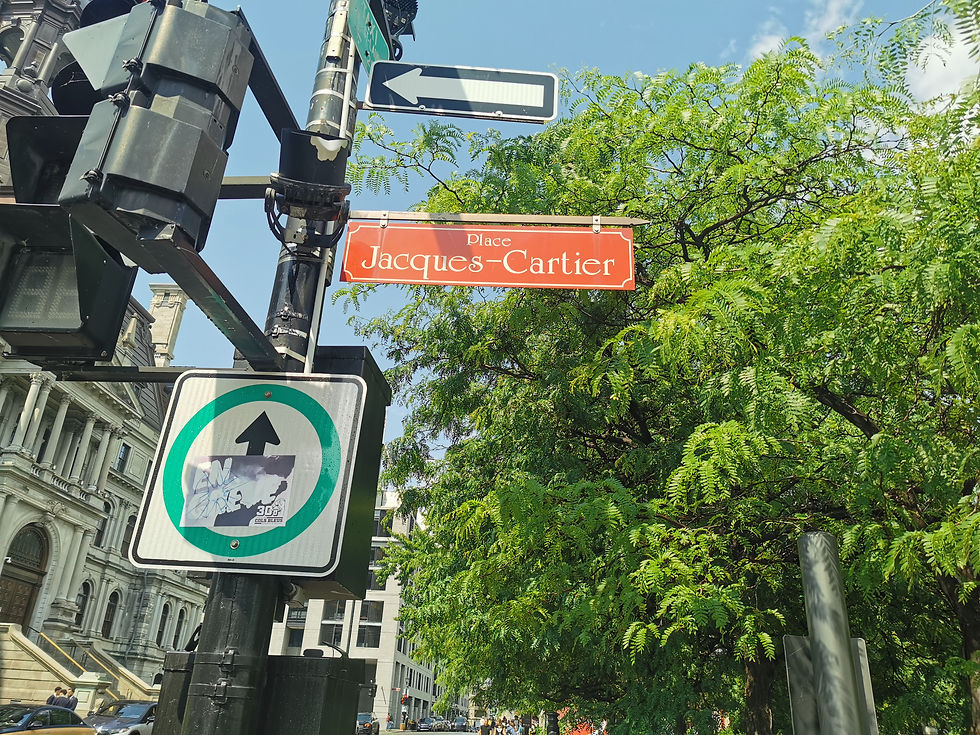
We contemplate Montreal’s beginning as we leave the museum to wander the history-soaked streets of Old Montreal. We feel like modern-day explorers as we discover Montreal’s treasures: the Basilique Notre-Dame de Montreal, considered a masterpiece of the Gothic Revival; Old Saint Sulpice Seminary; Montreal City Hall, rebuilt after a fire gutted it in 1922; Place Jacques Cartier; Château Ramezay, an historical gem that was originally the residence of Montreal’s then-governor Claude de Ramezay from 1704-1724; and the Fine Arts Museum, the largest art museum by gallery space in Canada.



A more recent historical building is of particular interest to me — the Montreal Biosphere. I’d always regretted not having the chance to go to Expo 67 and see this iconic geodesic dome designed by Buckminster Fuller. Seeing the dome almost fifty years later doesn’t live up to my expectations. A fire in 1976 destroyed the transparent acrylic bubble, leaving only the hard steel truss structure. More interesting is the interactive museum inside, which features informative exhibitions on current environmental issues.

Montreal Biosphere Photo: Noel Van Raes

Wanting to see the city from the water, we head to the Old Port of Montreal, where we’re greeted by young people dressed in historical military garb like that worn by soldiers from the 17th to 19th centuries. Replica rifles add even more realism. Chatting to the “soldiers,” we can almost pretend we’ve headed back in time. I can imagine historic scenes of everyday life — streets bustling with crowds of people shopping and socializing and children playing in the streets while soldiers stand on guard.


It’s the perfect introduction to our ferry ride, a scenic 4.3 kilometre journey along the St. Lawrence, around Ile St. Helene to the Longueuil Marina, where we walk a short path along the water, soaking in the beauty of this majestic river. The hour-long wait for the next ferry back flies by.


As a foodie, I’d be remiss if I didn’t talk about the deservedly famous international cuisine for which Montreal is known. A potpourri of restaurants from dozens of countries reflects the diversity of food, making every meal a major decision. Food trucks never fail to draw us in and we indulge regularly in poutine, that messy mixture of fries, cheese curds and gravy, a symbol of Québécois culture now popular throughout Canada.

But Montreal is not just famous for its international cuisine. It’s a city of music lovers. And nowhere is this more reflected than in the Festival International de Jazz de Montreal. Over 350 concerts take place across the city, with roughly two-thirds of them free. It’s our second time here and it just keeps getting better. The vibrant music scene includes performances by renowned artists and emerging talents across diverse genres of jazz, blues and world music.

But it’s a little too vibrant on our last evening as we attempt to leave the festival. Crowds that exceed expectations have us literally trapped. All movement is incremental, a few centimetres at a time. It’s a dangerous situation and any triggering event could cause panic, with a potential stampede to get out. It takes us more than an hour to go the three blocks to the exit. A kind Montrealer keeps up encouraging remarks and gauges our progress as she’s familiar with the area.
Relieved to finally be out of the suffocating crowd, we head back to our room to pack for our next destination — Quebec City.

We’re in for a surprise as we approach Quebec City the following day. We assume we’ll be crossing a bridge into the city but our GPS has other ideas, directing us to the ferry linking Old Lévis to Old Quebec. The twenty-minute ferry ride gives us enough time to exit our car and savour the view of Old Quebec’s enchanting architectural landscape, with the Fairmont Le Château Frontenac perched regally on a hill. We don’t stay at the hotel as it’s out of our price range, but we do go inside to admire the opulent interior lobbies before hitting the streets of Old Quebec.


Once again, history has a lesson for us. Astonishingly, this world-renowned UNESCO Heritage Site, founded by Samuel Champlain in 1608, is the only fortified city with intact walls that remains north of Mexico. Its ramparts, gates and Citadelle (a fortified fortress) enclose most of Old Quebec. Overlooking the St. Lawrence River, the stunning Citadelle has been the second official home and workplace of Canada’s governor general since 1872.


However, the walls of Quebec City, originally built in 1690 for defense, didn’t stop the British. On September 13, 1759, the British defeat of the French at the Battle of the Plains of Abraham altered the balance of power in North America, initiating the coexistence of French and British institutions. The Quebec Act of 1774, allowing the French to retain their language, religion and legal system, was a key moment in Canadian history, laying the foundations for dual cultural identities that remain in Canada today.

At the heart of the city’s political heritage lies the Parliament of Quebec. Completed in 1886, the historic building reflects the architect Eugène-Étienne Taché's desire to keep Quebec’s political history in the public eye by integrating historical elements into the facade. A fun fact: it was Tache who created the famous motto, Je me souviens (I remember), which is engraved above the main entrance of the Parliament Building and now found on all Quebec licence plates.


Open to the public, the Parliament of Quebec offers free hour-long tours in French and English. While the National Assembly Chamber (Salon bleu), a meeting place for members of the Legislative Council, and the Salon rouge, now used for ceremonial occasions, are impressive, it’s the Speaker’s Gallery on the ground floor that catches my attention. Portraits of all former Speakers of the National Assembly since 1867 are displayed. All those stoic faces, their eyes peering out from the past, make me wonder what they were thinking.

Our journey into the past continues at the Musée de la civilisation — a thought-provoking tour of human history that highlights key historical events that shaped Quebec society. Its information acquaints the visitor with Quebec’s Indigenous peoples, showcasing their cultural diversity and how their ways of life have evolved over the centuries. A wandering guide advises us to head to the rooftop before leaving. It’s great advice — the view is a captivating snapshot of local history.


Both Old Quebec and Old Montreal are engaging cornucopias of historic landmarks and well-preserved 17th-century architecture that tell the tales of their rich past. Wandering their narrow cobblestone streets evokes the ambiance of a European city, all without leaving the country.
Elbows up, Canada!


Comments