Alluring Almaty

We meander slowly through Almaty’s Green Bazaar, Kazakhstan’s oldest, enveloped by its vibrant sights, sounds, and smells. As foodies, we can spend a lot of time in markets. But it’s not only the food that enthralls us — markets are a dynamic world of discovery, a window into the history, culture, and daily lives of a people.

Coriander, black cumin, black pepper, sesame seeds and parsley are popular.

Kazakhs are heavy tea drinkers.
Row after row of meat stalls — chicken, goat, sheep, pork, and beef — dominate the market, but horse draws the longest queues, while camel, a more expensive option, is valued more for its milk. Kazy, or horse sausage, is especially prized. Nearby, dairy counters showcase yogurt, kefir, cheese, fermented milks of various animals, and the ubiquitous kurt, tangy dried milk balls.

Horse meat is prized for celebrations and special occasions.

Horse sausage is a favourite.

Mutton is eaten on a regular day to day basis.

Surprisingly, pork is available in this predominantly Muslim country.
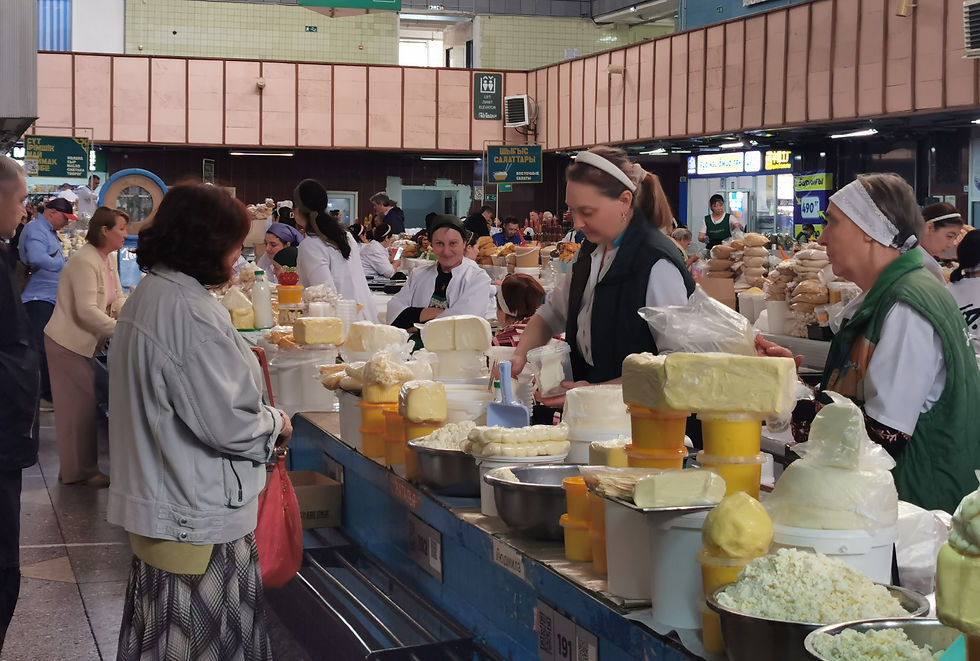
Cheese is a staple in Kazakh cuisine.
All are a reflection of this meat-loving nation’s past. Despite the culture’s ingrained reverence for horses and their past as indispensable means of transportation, they are eaten — a dichotomy for outsiders. But for their nomadic culture, horses were a dietary foundation, providing a sustainable, renewable food source crucial to survival in their harsh environment. Kazakhs still harbour a special bond with horses — a core part of their history, cultural heritage and national identity.

Kazakhs are fond of canned horse meat. Photo: Noel Van Raes
But it’s not only Kazakh foods found at the market — Kazakhstan is a multi-ethnic country. We spot Georgian churchkhela (walnuts threaded on a string and dipped in thickened grape juice), Ukrainian smoked pig lard, and Korean salad, a spicy marinated carrot dish, along with Tajik stalls filled with colourful, enticing displays of fruits and nuts.

Georgian churchkhela. We loved it when we first tried it in Uzbekistan several years ago and excitedly buy one of each to snack on.

Service with a smile. Nuts are always our go-to snack. Photo: Noel Van Raes
We’re surprised that the fruit and vegetables are pretty much the same as what’s available back home in Canada in the fall — potatoes, squash, watermelon, tomatoes, and carrots. But what stands out most are the numerous displays of different types of apples. A quick Google search tells us why. Almaty’s former name, Alma-Ata, literally translates to "Father of Apples”, a nod to its recognition as the birthplace of the modern domestic apple.


Over 100 varieties of apples are grown in Kazakhstan, some of which are known for their large size of 200-300 grams. Photo: Noel Van Raes
As tourists, we’re besieged by offers to try samples — always an opportunity for connection, albeit with help from Google Translate, to bridge the communication gap. And, as usual, we leave with enough for a family. But, no worries, it’s fun to share with locals on trains and buses.
Lugging our bulging shopping bags, we head to a local restaurant, excited to try beshbarmak. Although we have complicated feelings about eating horse meat, we want to experience this quintessential Kazakh tradition. Meaning “five fingers” for the way it's eaten with one’s hand, it’s Kazakhstan's national dish of mutton or horse served on a bed of flat noodles with a broth poured over the top. The horse is tender, reminiscent of beef but with a richer taste.

Beshbarmak.
Our server, all smiles when we placed our order, is even more delighted upon returning to hear we enjoyed Kazakhstan’s national dish.
Stepping out into the street after eating our fill, we meet up with Dennis, our walking tour guide. Walking Almaty’s leafy pedestrianized streets is the perfect way to get to know the city, and Dennis, a longtime American expat, is a specialist in Central Asian history and culture. As he points out an array of architectural styles — from extravagant Stalinist buildings to brutalist edifices of Soviet Modernism — he shares his in-depth knowledge and insight into Kazakh culture. Numerous statues of historical figures acquaint us with Kazakhstan’s past, while fountains provide a gathering place for socializing locals.

The National Academy of Sciences, a charming example of Soviet architecture in the Stalin era.

Hotel Kazakhstan, a famous landmark in Almaty, is a notable example of Soviet Modernism.

Monument to Viktor Tsoi, a beloved Soviet rock musician, songwriter and poet.
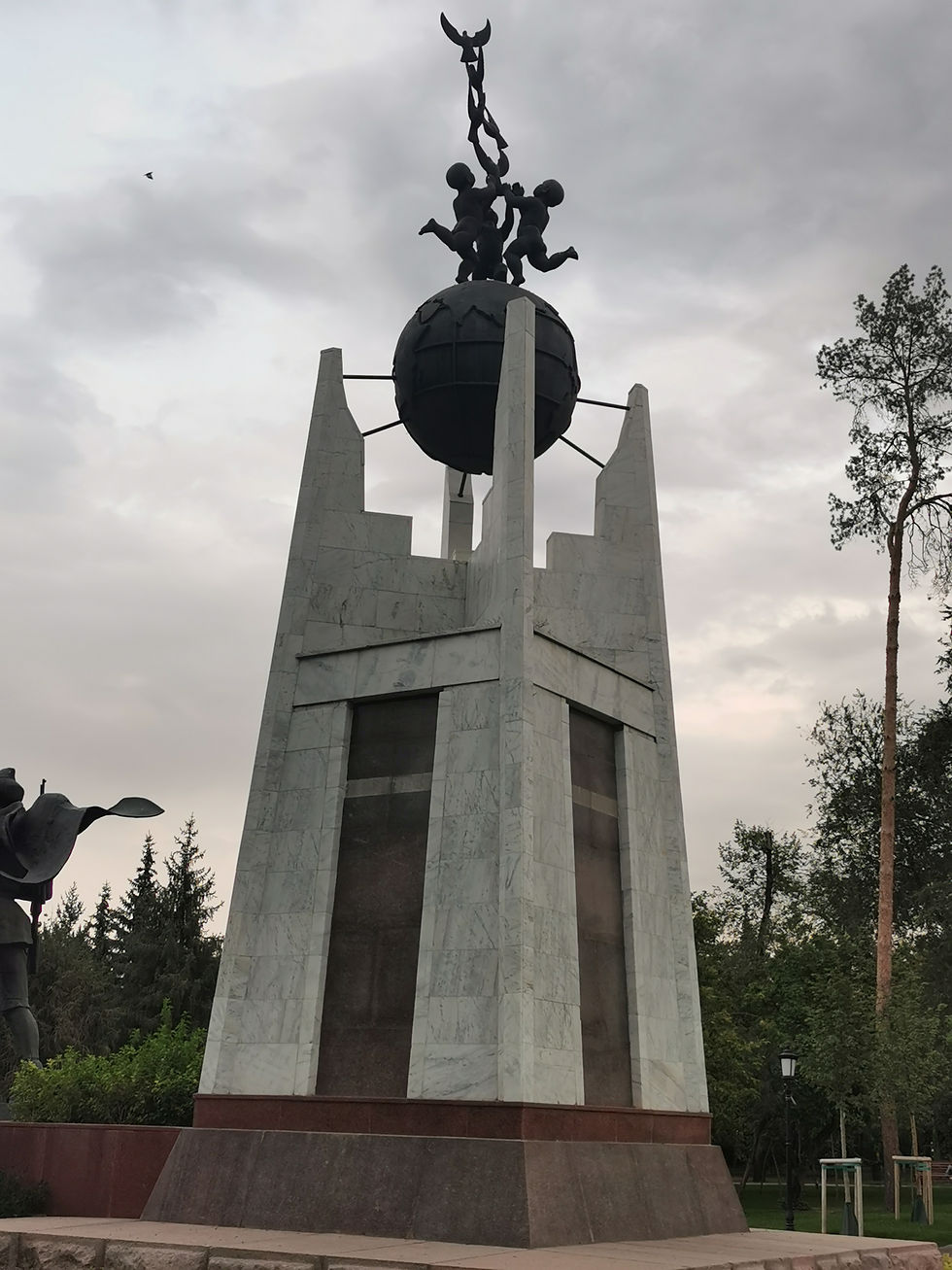
A monument to Manshuk Nametova and Aliya Moldagulova celebrating their bravery and heroism during World War 1.
We’ve already noticed that speaking English as we walk around Almaty often attracts furtive glances. English is now a mandatory subject at school, and groups of tittering young people nudge one another until one approaches to hesitantly ask, “Where are you from?” Surprised to hear we are from Canada, we get an enthusiastic “Welcome to Kazakhstan!” from the entire group. We’re charmed by their welcome and the overall helpfulness of other locals for whom not speaking English isn’t a barrier to their hospitality.

School children are always eager to say hello to us. Photo: Noel Van Raes
Our two-hour tour with Dennis flies by and he bids us a wonderful stay in Almaty, as we arrive at Panilov Park, a popular spot for both visitors and locals, who enjoy just strolling and hanging out in the shaded walkways. The plaza in front of the marvellous Zenkov Cathedral, the centrepiece of the park, is packed with families enjoying a day out. Built entirely of wood, including the nails, this colourful cathedral was one of the only buildings to survive the catastrophic 1911 earthquake, an 8.2 seismic event that killed 452 people and destroyed almost every building in Almaty.

Zenkov Cathedral, the centrepiece of Panilov Park.

The plaza is popular with families.

The perfect backdrop for wedding photos.
A short walk away, monuments commemorate the heroism of the Red Army in defending Moscow in World War II, known in Kazakhstan as the Great Patriotic War. As a former part of the Soviet Union, Kazakhs were subject to extremely high conscription rates, many of those sent to the front line, resulting in high casualty rates among both soldiers and civilians. An eternal flame burns in their memory.

Memorial of Glory.


Reminders of World War II are scattered throughout Panilov Park.

Noel can't resist the war memorabila.
Kazakhstan’s history dates much further back than the Soviet times, though. The Central State Museum takes us on a fascinating journey through that history. A large replica of the Golden Man, an ancient 2nd-3rd century BCE Scythian warrior, whose remains were discovered with gold-embroidered armour and regalia, greets us in the entrance hall. From there, we take a trip back from World War II to the Bronze Age and nomadic culture via an astonishing array of beautiful artifacts. And all of this for the admission price of a dollar.

Central State Museum, Almaty.

Replica of the Golden Man.

Early Soviet technology.

Ancient rock carvings.

Ammonite, an extinct marine fossil.
To cap off our stay in Almaty, we take a trip on the subway. But it’s not the ride we’re interested in — it’s the stations. Banish any thoughts of drab, dreary designs: all eleven are extravagantly decorated. We’re astounded from the get-go. Their opulence is breathtaking, making us feel as if we’re in an underground palace rather than a metro station. Artwork and stunning architecture transform each uniquely designed station into an art gallery, showcasing national heritage. Eye-catching marble and granite mosaics exhibit Kazakh national motifs celebrating the country's history and culture. Not only are the stations exquisite — the entire metro is also constructed to withstand extreme seismic activity.


Photo: Noel Van Raes

The staff are always helpful. Photo: Noel Van Raes
Constructed primarily after the Soviet era, the Metro represents Kazakhstan’s resilience and dedication to modernization and identity as an independent nation following the 1991 dissolution of the Soviet Union. Although no longer the capital of Kazakhstan, Almaty remains the cultural and economic centre of the country.
After five days wandering Almaty’s parks and tree-lined streets, lingering at its fountains and people watching at its many cafes, it feels like home. But it’s time to move on. New adventures await in Astana, Kazakhstan’s new capital city.

Flowers shops dot the streets.

Outdoor restaurants and cafes are popular in warm weather.

Stocking up on plums.


Comments